I created this page because I know how isolating illness can feel — for the person going through it and for the people who love them. Below you’ll find links, tools, and guides. Some are for patients, some for caregivers, some for children and young adults, some for mental health, and some are simply here to remind you that you aren’t alone. Bookmark this page. Share it. Come back to it whenever you need.
🩺 For Patients
- CancerCare – Free counseling, support groups, and financial help.
- The American Cancer Society – Information on treatments, side effects, and local resources.
- METAvivor – Support and funding for metastatic breast cancer.
- Cancer Financial Assistance Coalition (CFAC) – Help with treatment-related costs.
- Young Survival Coalition – Support specifically for young women with cancer.
- Triage Cancer – Legal, financial, and practical support for patients.
- Livestrong Foundation – Navigation services, fertility preservation, and survivorship programs.
- Patient Advocate Foundation – Case management and financial navigation for those in treatment.
🤍 For Caregivers & Loved Ones
- The Caregiver Action Network – Resources and support groups for caregivers.
- Family Reach – Financial help for families facing cancer.
- Lots of Helping Hands – Tools to organize meals, rides, and support calendars.
- Well Spouse Association – Support for partners caring for chronically ill or disabled spouses.
- Cancer Support Community – Groups, education, and connection for caregivers and families.
🧒 For Children, Teens & Young Adults
- Kesem – Free summer camps and year-round support for kids (ages 6–18) who have a parent with cancer.
- Stupid Cancer – Community, programs, and support for young adults affected by cancer.
- Teen Cancer America – Support and resources specifically for teens and young adults with cancer.
- Elephants and Tea – A magazine and community written by and for young adults impacted by cancer.
- Camp Mak-A-Dream – Free medically supervised camps for children, teens, and young adults affected by cancer.
🧠 Mental Health & Crisis Support
Because cancer doesn’t just affect the body — it takes a toll on the mind, too. Please know there is help, even in the darkest moments:
- 988 Suicide & Crisis Lifeline – Dial 988 (U.S.) to connect with trained crisis counselors, anytime.
- Crisis Text Line – Text HOME to 741741 (U.S.) to connect with a counselor.
- National Alliance on Mental Illness (NAMI) – Education, support groups, and a helpline: 1-800-950-NAMI.
- SAMHSA’s Helpline – Free, confidential help for mental health or substance use: 1-800-662-HELP.
- Psychology Today’s Therapist Directory – Find mental health professionals near you.
- Headspace & Calm – Apps for guided meditation, breathing, and coping strategies.
💵 Financial & Practical Help
- NeedyMeds – Drug discount programs and copay help.
- Good Days – Assistance covering the cost of medications.
- The Pink Fund – Non-medical financial support for breast cancer patients.
- HealthWell Foundation – Copay and financial help for people with chronic or life-threatening conditions.
- GoFundMe & Give InKind – Platforms many families use for financial and community support.
🎒 Things That Can Help During Treatment
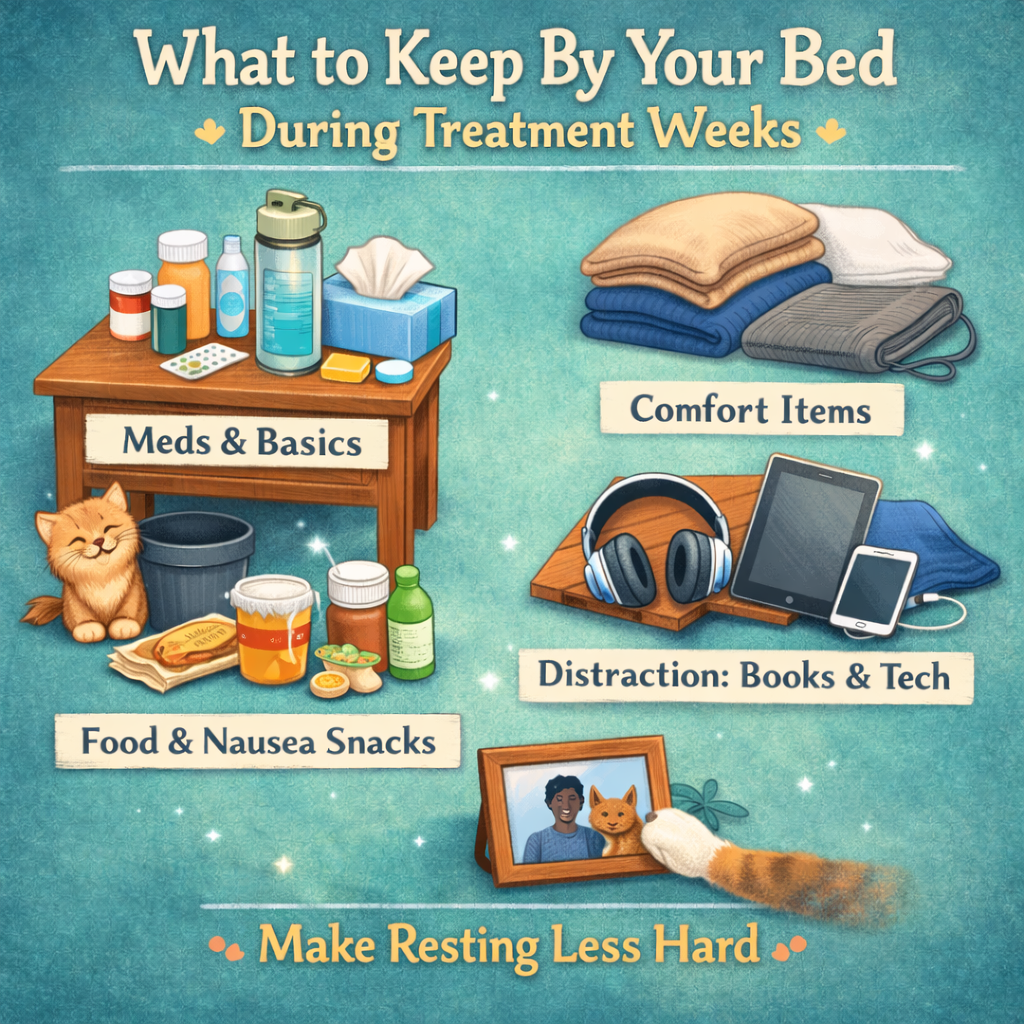
Sometimes the little things make the biggest difference. Here’s a list of items many patients (myself included) have found helpful:
- Warm blanket or shawl
- Comfy socks or slippers
- Water bottle with straw
- Lip balm & unscented lotion
- Headphones & playlists
- Notebook or journal
- Bland snacks (crackers, pretzels, mints)
- Pillow or neck support
- Entertainment (book, Kindle, downloaded movies)
- Hand sanitizer & wipes
- Comfort object (photo, charm, stuffed animal)
- Moisture drops for eyes
- Phone charger/portable charger
🎁 Care Package Ideas
So many people ask, “What can I do for someone going through treatment?” The truth is, it’s often the small, thoughtful things that make the biggest difference. If you’re putting together a care package for a loved one, here are some ideas:
Comfort Items
- Soft blanket or cozy throw
- Warm socks or slippers
- Eye mask for naps or hospital stays
- Small pillow or neck cushion
Practical Helpers
- Reusable water bottle with a straw
- Lip balm & unscented lotion
- Hand sanitizer & wipes
- Moisturizing eye drops
- Portable phone charger
Snacks & Sips
- Bland crackers, granola bars, pretzels
- Herbal or ginger tea
- Sugar-free candies or mints
- Favorite comfort snacks (if tolerated)
Entertainment & Distraction
- Crossword puzzles or word search books
- Adult coloring books & pencils
- A new novel or Kindle gift card
- Downloaded shows, playlists, or audiobooks
- Journal for thoughts, questions, or venting
Personal Touches
- Handwritten letters or encouraging notes
- Photos or drawings
- Cozy hoodie, beanie, or head wrap
- Small stuffed animal or charm
- Gift cards (Uber Eats, Amazon, Target)
💡 Tip: Ask about dietary restrictions, avoid strong fragrances, and remember — sometimes the most meaningful gift is simply presence, a ride to an appointment, or help with everyday tasks.
🐾 For Comfort
Because sometimes the best medicine has fur, paws, and unconditional love:
- Therapy Dog Programs – Many hospitals and cancer centers partner with therapy dog volunteers.
- Pet Partners – National registry for therapy animals.
- Mojo’s Corner 🐶 – I’ll keep sharing his POV posts here, because laughter and love are medicine too.
Medical & Diagnostic Terms
Benign – A growth that is not cancerous and does not spread to other parts of the body.
Biopsy – A procedure where a small piece of tissue is removed and examined to determine if cancer is present.
Carcinoma – Cancer that starts in epithelial cells (skin, organs, glands). The most common type of cancer.
Sarcoma – Cancer that begins in bones, muscles, fat, or connective tissue.
Lymphoma – Cancer that begins in the lymphatic system.
Leukemia – Cancer of the blood or bone marrow.
Tumor – An abnormal mass of tissue. Can be benign or malignant.
Malignant – Cancerous; able to grow, invade nearby tissue, and spread.
Metastasis – When cancer spreads from its original site to other parts of the body.
Stage – Describes how advanced the cancer is (size, spread, lymph node involvement).
Grade – How abnormal cancer cells look under a microscope and how fast they’re likely to grow.
Margins – The edges of tissue removed during surgery. “Clear margins” means no cancer cells were found at the edges.
Lymph Nodes – Small structures that filter lymph fluid; often the first place cancer spreads.
Sentinel Node – The first lymph node cancer is likely to spread to.
PET Scan – Imaging test that shows cancer activity in the body.
CT Scan – Imaging test that shows detailed internal images.
MRI – Imaging that uses magnets and radio waves to show soft tissue details.
Bone Scan – Imaging to check for cancer spread to bones.
Recurrence – Cancer that comes back after treatment.
Remission – Reduction or disappearance of cancer signs and symptoms.
Progression – Cancer that is growing or spreading despite treatment.
Stable Disease – Cancer that is not significantly growing or shrinking.
Treatment Terms
Chemotherapy (Chemo) – Drugs that kill or slow the growth of cancer cells.
Targeted Therapy – Drugs designed to attack specific cancer cell features.
Immunotherapy – Treatment that helps the immune system fight cancer.
Radiation – High-energy rays used to kill cancer cells.
Hormone Therapy – Treatment that blocks hormones fueling certain cancers.
Infusion – Medication given through an IV.
Port – A small device implanted under the skin for easier IV access.
Oral Chemo – Cancer medication taken by mouth.
Maintenance Therapy – Ongoing treatment to keep cancer from returning or progressing.
Line of Treatment – The order of therapies tried (first-line, second-line, etc.).
Clinical Trial – Research study testing new cancer treatments.
Palliative Care – Care focused on comfort, symptom management, and quality of life (not the same as hospice).
Hospice – Care focused on comfort when treatment is no longer working.
Side Effects & Symptom Terms
Neuropathy – Nerve damage causing numbness, tingling, or pain.
Brain Fog / Chemo Brain – Trouble with memory, focus, or thinking clearly.
Fatigue – Extreme exhaustion not relieved by rest.
Nausea – Feeling sick to the stomach.
Mucositis – Painful inflammation of the mouth or digestive tract.
Alopecia – Hair loss.
Lymphedema – Swelling caused by lymph fluid buildup.
Bone Pain – Pain caused by cancer or treatment affecting bones.
Hot Flashes – Sudden feelings of heat, often hormone-related.
Steroid Crash – Fatigue, mood changes, or weakness after steroids wear off.
Cancer Reality Terms (Patient-Made Language)
Scanxiety – Anxiety before scans or results.
Cancer Math – Doctors explaining odds that feel meaningless when you’re the statistic.
New Normal – Life after cancer diagnosis that never feels normal.
The Waiting Room Life – Constant appointments, labs, scans, and delays.
Chemo Hangover – The days after treatment when symptoms hit hardest.
Treatment Limbo – Waiting to see if something worked.
Cancer Muggle – Someone who has never had cancer and doesn’t get it (no offense, mostly).
Invisible Symptoms – Side effects others can’t see but deeply affect daily life.
Good Patient – Someone praised for compliance, not necessarily honesty.
Medical Trauma – Emotional distress caused by repeated procedures, pain, or loss of control.
Common Phrases You’ll Hear (And What They Usually Mean)
“We’ll keep an eye on it” – No action right now, but you’re not imagining it.
“This is treatable” – There are options, not guarantees.
“Everyone responds differently” – No one can predict how this will go.
“It’s stable” – Not better, not worse — a waiting game.
“We have another option” – The current one didn’t work.
“Let’s rescan in a few months” – More waiting.
Emotional & Mental Health Terms
Anticipatory Grief – Grieving losses before they happen.
Survivor’s Guilt – Feeling guilty for surviving when others didn’t.
Medical Burnout – Emotional exhaustion from constant treatment and appointments.
Loss of Identity – Feeling like cancer replaced who you were.
Hypervigilance – Always waiting for the next symptom or shoe to drop.
Caregiver & Support Terms
Caregiver Fatigue – Burnout experienced by those supporting a patient.
Secondary Trauma – Emotional toll on loved ones witnessing illness.
Advocate – Someone who speaks up for the patient in medical settings.
✍️ If You’re Here Because You’re Hurting
You’re not alone. Whether you’re fighting, caregiving, grieving, or just trying to make it through another day — I hope this blog helps you feel less isolated.
If any of these resources save you a phone call, a sleepless night, or a moment of despair, then this page has done its job. Please share it with anyone who might need it. And if you want to stay connected, please subscribe to the blog — this community was built to carry each other.