I’m tired.
Not just because I’m sick.
I’m tired of hearing the same story from women over and over again.
“I asked for a mammogram, but they said I was too young.”
“I wanted a hysterectomy, but they said I might change my mind about having children.”
“They told me to wait six months.”
“They said it was probably hormones.”
“They said it was anxiety.”
“They said to lose weight.”
“They said to try birth control.”
“They said to come back if it got worse.”
How much worse are we expected to let it get?
How much pain are we supposed to tolerate before someone decides it’s finally worth investigating?
How many appointments should we have to schedule before someone believes us the first time?
Somewhere along the way, women became expected to prove they deserve healthcare.
Not because we don’t know our bodies.
Because we’re constantly told someone else knows them better.
We’re expected to convince strangers that our pain is real. That the bleeding isn’t normal. That the lump wasn’t there before. That the exhaustion isn’t just because we’re busy. That something has changed.
And if we cry, we’re emotional.
If we stay calm, it must not be that serious.
If we push for answers, we’re difficult.
If we don’t, we’re told we should’ve advocated for ourselves sooner.
It’s an impossible game.
This isn’t just about cancer.
It’s about the woman who’s told her pelvic pain is “just bad periods” only to later learn she has endometriosis or adenomyosis.
It’s about the woman who spends years bleeding through her clothes because her fibroids are dismissed as something she should simply learn to live with.
It’s about the woman whose autoimmune disease is brushed off as stress.
It’s about the woman whose chest pain is mistaken for anxiety.
It’s about every woman who walked into an appointment looking for answers and walked out carrying doubt instead.
Women are told they’re too young for breast cancer.
Until they aren’t.
Too young for uterine cancer.
Until they aren’t.
Too young for ovarian cancer.
Until they aren’t.
Too young to need a colonoscopy.
Until they aren’t.
Too young to lose their fertility.
Until they aren’t.
Too young.
Until suddenly they’re the exception everyone acts surprised by.
I was young too.
Cancer didn’t care how old I was.
It didn’t ask whether I had checked enough boxes first.
It didn’t wait for me to have children.
It didn’t care what statistics said.
Disease rarely reads the rules we write for it.
We praise early detection while putting roadblocks in front of the very people trying to catch something early.
We tell women to know their bodies.
To perform self-exams.
To pay attention to changes.
To speak up if something feels wrong.
Then when they do…
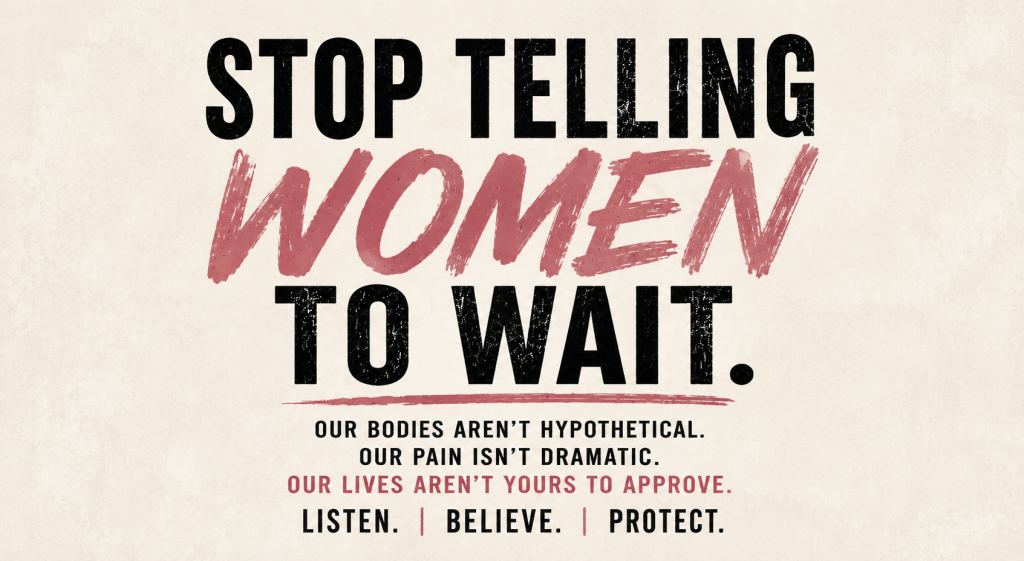
They’re told to wait.
Wait until you’re older.
Wait until you’ve had children.
Wait until the insurance company approves it.
Wait until you’ve failed other treatments.
Wait until the symptoms become undeniable.
Wait until the tumor is bigger.
Wait until the bleeding is heavier.
Wait until the pain becomes unbearable.
Wait.
Disease doesn’t wait.
Cancer doesn’t wait.
Endometriosis doesn’t wait.
Fibroids don’t wait.
Heart disease doesn’t wait.
Autoimmune diseases don’t wait.
The clock keeps moving while women sit in waiting rooms wondering if they’re imagining it.
And can we please talk about how often women’s futures are treated like public property?
A woman asks for a hysterectomy after years of pain, and somehow the conversation becomes about a hypothetical husband she may never meet.
A hypothetical child she may never have.
A hypothetical future that somehow carries more weight than the very real suffering she’s experiencing today.
Why?
Why are women expected to sacrifice the bodies they’re living in for lives other people imagine they might have someday?
Why do we trust women to raise children but not always to decide whether they want them?
That isn’t healthcare.
That’s paternalism disguised as protection.
I’m not saying every woman needs every test.
I’m not saying every symptom is cancer.
I’m saying women deserve to be heard before they’re dying.
They deserve conversations instead of dismissal.
Curiosity instead of assumptions.
Partnership instead of permission.
Because here’s the part that stays with me.
I’ve met far too many women whose stories begin the exact same way.
“I knew something was wrong.”
Not one dramatic moment.
Just a quiet certainty.
A feeling they couldn’t shake.
And almost every one of them was told to wait.
Some of them were lucky enough to still have time.
Some weren’t.
Maybe that’s what hurts me the most.
Somewhere today, another woman is sitting in a parking lot after an appointment wondering if she’s crazy.
She’s replaying the conversation in her head.
Maybe they were right.
Maybe I’m overreacting.
Maybe I should just wait.
Maybe it’s all in my head.
She’ll go home and try to convince herself she’s fine because someone with a degree told her she was.
She’ll apologize to her family for making such a big deal out of it.
She’ll tell herself she’ll give it another few months.
I hope she’s okay.
God, I hope she’s okay.
But I also know some of them won’t be.
Some of them will eventually hear the words, “I wish we’d caught this sooner.”
Some will lose organs they might have been able to save.
Some will lose their fertility.
Some will lose years of their lives.
Some will lose their lives altogether.
Not because they ignored their bodies.
Because someone else did.
We have built a healthcare culture where women are praised for advocating for themselves while simultaneously being punished for doing it.
We’re told to speak up.
Then we’re called anxious.
We’re told to trust our instincts.
Then we’re told Google made us paranoid.
We’re told early detection saves lives.
Then we’re denied the very tools that make early detection possible.
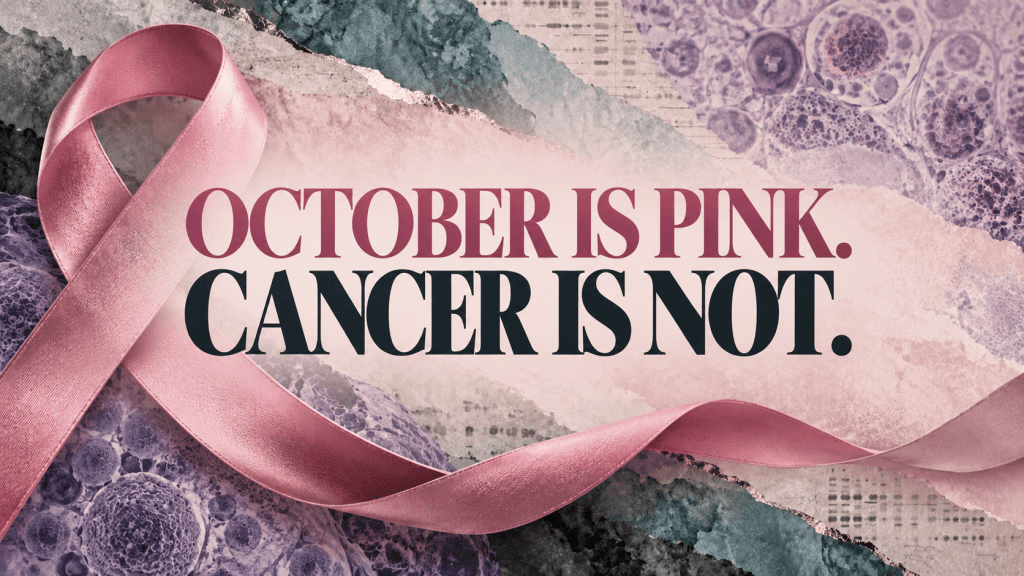
We celebrate survivors every October.
We share pink ribbons.
We raise money.
We light buildings.
But awareness means very little if women still can’t get through the front door when they’re asking for help.
I don’t want another awareness campaign if women are still being told they’re too young.
I don’t want another commercial telling me to know my body if the people responsible for listening refuse to hear what it has to say.
I don’t want another slogan.
I want women to be believed.
I want doctors to have the time to listen.
I want insurance companies to stop deciding which tests are “worth it.”
I want young women to stop being treated like statistics instead of human beings.
Because statistics don’t sit across from an oncologist.
People do.
Statistics don’t have families waiting at home.
People do.
Statistics don’t write goodbye letters.
People do.
And if this makes anyone uncomfortable, good.
It should.
Because women have spent generations swallowing pain to make everyone else comfortable.
I’m done with that.
If my story has taught me anything, it’s this:
Being young doesn’t protect you.
Looking healthy doesn’t protect you.
Having no family history doesn’t protect you.
Being told, “It’s probably nothing,” doesn’t protect you.
Listening saves lives.
Believing women saves lives.
Earlier answers save lives.
If this reaches one woman who’s been questioning herself because someone told her she was “too young,” “too dramatic,” or “too anxious,” let this be the permission she never should’ve needed.
Go back.
Ask again.
Get another opinion.
Find another doctor.
Your life is worth being the patient who asks one more question.
I’d rather you hear, “Everything looks normal,” a hundred times than hear, “I wish we’d found it sooner.”
Thank you for being here.
Whether you’ve been reading Mojo & The Mess since the beginning or this is the first post you’ve stumbled across, I’m grateful you took the time to read this.
This space has become so much more than a cancer blog. It’s a place for honest conversations about illness, grief, healthcare, hope, and everything in between. It’s where I share the things that are often left out of doctor’s appointments and awareness campaigns.
If you’d like to keep reading, I’d love to have you join our community. You can subscribe for free and have every new blog delivered straight to your inbox. No spam. No hidden fees. Just honest stories, resources, and reminders that none of us have to navigate this alone.
And if you leave with only one thing, let it be this:
You know your body.
If something feels wrong, keep asking.
Keep pushing.
Keep advocating.
Don’t let “wait” be the last answer you accept.




Leave a Reply